


.jpg)

Pemanfaatan Lahan Pertanian Desa Teuladan, Aceh Besar untuk Budidaya Nilam Berkelanjutan

(1) Universitas Syiah Kuala
(2) Universitas Syiah Kuala
(3) Universitas Syiah Kuala
(4) Universitas Syiah Kuala
(5) Universitas Syiah Kuala
(6) Universitas Syiah Kuala
(7) Universitas Syiah Kuala
(8) Universitas Syiah Kuala
(9) Universitas Syiah Kuala
(10) Program Studi Pendidikan Ekonomi Universitas Serambi Mekkah
(*) Corresponding Author
Abstract
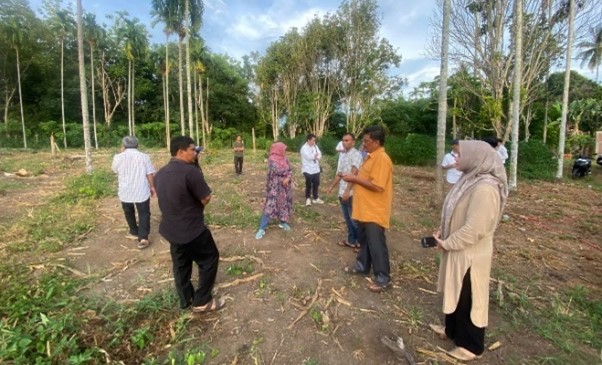
The global demand for patchouli oil as a raw material in the perfume industry is considerably high. However, the supply from exporting countries, particularly Indonesia, remains suboptimal. Aceh Province, one of Indonesia's key producers of patchouli oil, has been expanding its patchouli farming areas as a strategy to enhance productivity. Nevertheless, not all agricultural lands are suitable for patchouli cultivation. Therefore, it is essential to identify agricultural land resources that are ideal and sustainable for patchouli farming. The utilization of new potential lands could positively impact patchouli oil productivity. Land identification and mapping were carried out through observations and by utilizing candidate land indicator instruments. These indicators include land quality, land type, accessibility, land security systems, drainage systems, water sources, groundwater quality, and vulnerability to natural disasters. This article outlines the stages of community engagement activities conducted to identify the potential for patchouli farming in Teuladan Village, Lembah Seulawah Subdistrict, Aceh Besar Regency. The process involved program socialization, focus group discussions (FGDs), and interviews with farmers using candidate land surveys. The findings indicate that the agricultural land in Teuladan Village is suitable for sustainable patchouli cultivation. With the availability of ideal land and sufficient knowledge of proper patchouli cultivation practices, it is anticipated that high-quality patchouli oil can be produced. This will directly contribute to improving the welfare of the local community, particularly the farmers in Teuladan Village.
Keywords
Full Text:
PDFReferences
Anantanyu, S., Permatasari, P., Winarno, J., Suwarto, S., & Wibowo, A. (2022). Strategi Komunikasi Pemasaran melalui Digital Marketing Minyak Kayu Putih Pada Kelompok Tani Hutan (KTH) Wonolestari, Desa Wonoharjo Boyolali. Jurnal Surya Masyarakat, 5(1), 60-67. https://doi.org/10.26714/jsm.5.1.2022.60-67
Authar, N. D. M., Puteh, A., & Alfiady, T. (2021). Structure, behavior, and market performance on marketing of patchie oil in Bukut Village, Terangun District Gayo Lues District. International Journal of Economic, Business, Accounting, Agriculture Management and Sharia Administration (IJEBAS), 1(2), 381-398. https://doi.org/10.54443/ijebas.v1i2.110
BPS (Badan Pusat Statistik). 2023. Jumlah Desa1/Kelurahan Menurut Kecamatan di Kabupaten Aceh Besar Tahun 2023.
Erwan, F. (2023). Stakeholder engagement analysis of one village one product (OVOP) movement in Aceh, Indonesia. Journal of Community Positive Practices, (3), 27-39. https://doi.org/10.35782/JCPP.2023.3.03
Maizi, H., & Sastra, H. Y. (2020, September). Mapping Upstream and Downstream Process in The Patchouli Oil Industry Using Supply Chain Operations Reference Model Version 12.0 (SCOR 12.0). In IOP Conference Series: Materials Science and Engineering (Vol. 931, No. 1, p. 012008). IOP Publishing.
https://doi.org/10.1088/1757-899X/931/1/012008
Rahmayanti, D., Hadiguna, R. A., Santosa, S., & Nazir, N. (2018). Determining the profit margin in ‘patchouli oil’ supply chain: A case study in Indonesia. Int. J. Adv. Sci. Eng. Inf. Technol, 8(2), 483-488. https://dx.doi.org/10.18517/ijaseit.8.2.3485
Rusli, M. S. (2010). Sukses memproduksi minyak atsiri. AgroMedia. Ernawati et al., 2021
Sampebua, M. R., & Suyono, I. J. (2022). E-Commerce Papua Tani sebagai Marketplace Hasil Pertanian Distrik Skanto Kabupaten Keerom Papua. Jurnal Surya Masyarakat, 4(2), 169-174. https://doi.org/10.26714/jsm.4.2.2022.169-174
Sulistyaningsih, C. R. (2020). Pemanfaatan limbah sayuran, buah, dan kotoran hewan menjadi Pupuk Organik Cair (POC) di kelompok tani Rukun Makaryo, Mojogedang Karanganyar. Jurnal Surya Masyarakat, 3(1), 22-31. https://doi.org/10.26714/jsm.3.1.2020.22-31
Widiaswanti, E., & Yunitarini, R. (2021). Conceptual model of essential oil agroindustry development by using system dynamics approach. In E3S Web of Conferences, 328, 05003. EDP Sciences. https://doi.org/10.1051/e3sconf/202132805003
Article Metrics
Abstract view : 449 timesPDF - 148 times
DOI: https://doi.org/10.26714/jsm.7.2.2025.329-336
Refbacks
- There are currently no refbacks.
Copyright (c) 2025 Jurnal Surya Masyarakat

Jurnal Surya Masyarakat (JSM) is licensed under Creative Commons Attribution-NonCommercial-NoDerivatives 4.0
------------------------------------------------------------------------------------------------------------------------
Jurnal Surya Masyarakat (JSM)
p-ISSN: 2623-0364; e-ISSN: 2623-0569
Published by: Lembaga Penelitian dan Pengabdian Masyarakat (LPPM) Universitas Muhammadiyah Semarang
Indexed by:





.jpg)